
Xander Becker · 11 October 2026
Adaptive Strategies of Bryophyte Leaf Structures in Response to Seasonal Moisture Fluctuations in Boreal Forests
Boreal forests span vast northern landscapes where bryophytes encounter pronounced shifts between snowmelt saturation in spring, summer desiccation events, autumn precipitation pulses, and prolonged winter freezing. These plants rely on leaf-level modifications that permit rapid water uptake during wet intervals while limiting loss when conditions turn arid. Researchers document such traits across species like Sphagnum and Polytrichum that dominate understory layers in Canada and Scandinavia. Leaf architecture in these mosses incorporates specialized cells and surface features that respond dynamically to humidity gradients. Hyaline cells in Sphagnum, for instance, function as external reservoirs that fill during rainfall and release moisture gradually to adjacent chlorenchyma tissue. Lamellae on Polytrichum leaves increase surface area for capillary retention, and studies from Finnish forest plots show these ridges remain effective even after repeated drying cycles. Awns and recurved margins further channel condensate toward the stem base, sustaining metabolic activity when ambient vapor pressure drops.Structural Features That Enable Water Regulation
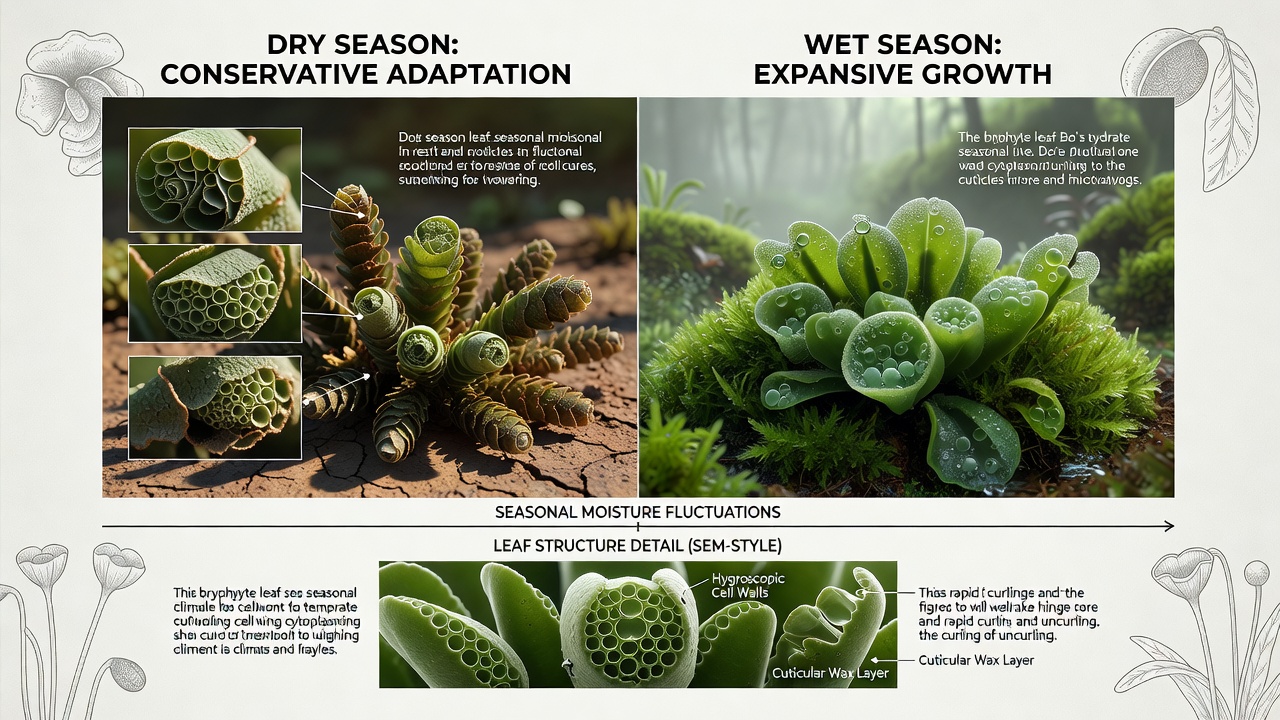
Many boreal bryophytes develop leaves with layered cell types that separate storage from photosynthesis. In October 2026 monitoring programs across central Canada, field teams recorded leaf curling in several Dicranum populations within hours of surface drying, a movement driven by differential shrinkage of abaxial and adaxial tissues. This reconfiguration reduces exposed area and slows transpiration without requiring active metabolism. Data from Natural Resources Canada boreal ecosystem surveys indicate that curled leaves retain 30 to 40 percent more internal moisture than flat ones under equivalent vapor deficits.
Additional adaptations include epicuticular waxes and thickened cell walls that appear in populations exposed to longer summer droughts. These modifications limit evaporative flux while still permitting rehydration when fog or rain returns. Electron microscopy of samples collected in Swedish boreal reserves reveals wax platelets that fracture and reform seasonally, preserving flexibility across temperature swings from below zero to above 25 degrees Celsius.
Seasonal Timing and Physiological Coordination
Spring thaw triggers rapid expansion of leaf tissues in many species because stored carbohydrates fuel cell elongation before new photosynthesis begins. Summer drought then induces synthesis of protective proteins within leaf cells, documented in laboratory assays that simulate boreal temperature and moisture regimes. By late season, renewed precipitation prompts reopening of curled structures and resumption of growth. Observers note that these cycles repeat reliably each year, allowing bryophyte mats to maintain net carbon gain despite fluctuating water availability.
Winter snow cover supplies insulation that keeps leaf temperatures near zero rather than far below, reducing cellular damage. When meltwater arrives, leaf surfaces absorb it within minutes through capillary action along margins and costal regions. Research coordinated by the University of Helsinki forest ecology group demonstrates that species with pronounced costae rehydrate faster than those lacking them, conferring competitive advantages in sites where snow duration varies with topography.
Interactions with Forest Microclimate
Canopy gaps created by windthrow or harvesting alter local humidity, prompting shifts in leaf morphology within individual colonies. Populations under denser cover retain flatter leaves suited to consistent moisture, whereas those in open areas develop more pronounced awns and thicker walls. Long-term transects in Russian taiga zones show these plastic responses occur within a single growing season and reverse when canopy conditions change. Such flexibility supports persistence across heterogeneous forest patches without requiring genetic differentiation.
Soil contact also influences leaf function because many bryophytes draw supplemental water from underlying organic horizons. Leaves positioned closer to the substrate exhibit stronger capillary uptake pathways that connect directly to moisture held in moss peat. Measurements taken during summer dry spells indicate these basal connections can sustain photosynthesis for days after surface layers have dried completely.
Conclusion
Leaf structures in boreal bryophytes integrate multiple anatomical and behavioral traits that track seasonal moisture patterns. Hyaline reservoirs, lamellae, curling mechanisms, and cuticular reinforcements operate in coordinated sequences that match the rhythm of snowmelt, drought, rain, and freeze-thaw events. Continued field observations through 2026 and beyond supply quantitative records of how these strategies maintain productivity in one of Earth’s largest forest biomes.